Showing posts with label science. Show all posts
Showing posts with label science. Show all posts
Friday, May 14, 2010

Tuesday, December 29, 2009
Michigan Water Pollution
One of my students, Alex, focused on Michigan Water Pollution as he developed his Glog for our Environmental Life Science research.
This is an area of personal concern for this environmental science enthusiast. His evidence of focus on his topic makes this interactive poster quite useful. I would direct you to his inclusion of leftover medicines in the water systems which is an overlooked, yet extremely detrimental water contamination problem.
Teachers could share this Glog as an example for students or as a teaching tool. As always, I would recommend that you cite this blog in your work.
This is an area of personal concern for this environmental science enthusiast. His evidence of focus on his topic makes this interactive poster quite useful. I would direct you to his inclusion of leftover medicines in the water systems which is an overlooked, yet extremely detrimental water contamination problem.
Teachers could share this Glog as an example for students or as a teaching tool. As always, I would recommend that you cite this blog in your work.
Tuesday, November 17, 2009
Fossil Fieldtrip Guide: fossil, poster, practice | Glogster
Fossil Fieldtrip Guide: fossil, poster, practice | Glogster
Use Glogster to make an interactive science poster.
Use Glogster to make an interactive science poster.
Saturday, November 14, 2009
Friday, November 13, 2009

Sunday, October 25, 2009
Using Animoto For Presentations
Using this sample Animoto video as a guide. You may use the Animoto web application to build a video from images and videos. Add your own music, or use the music available on the web application.
The video you create can represent one part of your Biodiversity presentation and can be transferred to Youtube or other presentation media.
The video you create can represent one part of your Biodiversity presentation and can be transferred to Youtube or other presentation media.
Thursday, October 15, 2009
Our Footprints: Heavy on the Land!

A man's steps by isolano.
Attribution-NonCommercial-NoDerivs License
If we hope to be the change we see in the world, let's start at home.
The Nature Conservancy has provided a wonderful, easy to use carbon footprint survey It can be used to determine your carbon footprint. Try it out and learn how you can lighten the burden on Earth.
Thursday, December 11, 2008
Earth System Science: What is it?
Since World War II, the explosion in scientific knowledge naturally led many scientists and educators, to specialize in one discipline or another. Even within a scientific discipline, such as ecology, now called environmental studies, there were many specializations. Some include water ecology, habitat studies, population studies, etc. After a half century, the over-emphasis on specialization became so pronounced, that many believed that integration among various scientific disciplines must be established anew.
 This integration is most pronounced in the scientific disciplines representing any part of studies of the Earth, namely Geology, hydrology, meteorology, biology and others. A new integrated Earth Science discipline, referred to as Earth System Science, was created. The push for this integration with Earth Science was promoted most actively by the National Science Foundation (NSF) and the National Aeronautic and Space Administration (NASA).
In most scientific and education quarters, it is now recognized that people can understand how the Earth works and how we interact with the Earth, if we teach the subject in a more project based manner. Earth Science teachers are encouraged to include all the systems of the Earth in their classes. If Earth Science teachers have a greater understanding of the various spheres of the living and nonliving parts of the Earth as a system, they can effectively explain and teach Earth System Science.
To encourage you to have a basic understanding of the Earth System Science as a scientific discipline, I have included an Earth System Science WebSlide.
 This integration is most pronounced in the scientific disciplines representing any part of studies of the Earth, namely Geology, hydrology, meteorology, biology and others. A new integrated Earth Science discipline, referred to as Earth System Science, was created. The push for this integration with Earth Science was promoted most actively by the National Science Foundation (NSF) and the National Aeronautic and Space Administration (NASA).
 In most scientific and education quarters, it is now recognized that people can understand how the Earth works and how we interact with the Earth, if we teach the subject in a more project based manner. Earth Science teachers are encouraged to include all the systems of the Earth in their classes. If Earth Science teachers have a greater understanding of the various spheres of the living and nonliving parts of the Earth as a system, they can effectively explain and teach Earth System Science.
To encourage you to have a basic understanding of the Earth System Science as a scientific discipline, I have included an Earth System Science WebSlide.
Thursday, November 13, 2008
Peak Oil: View from Hubbert's Peak
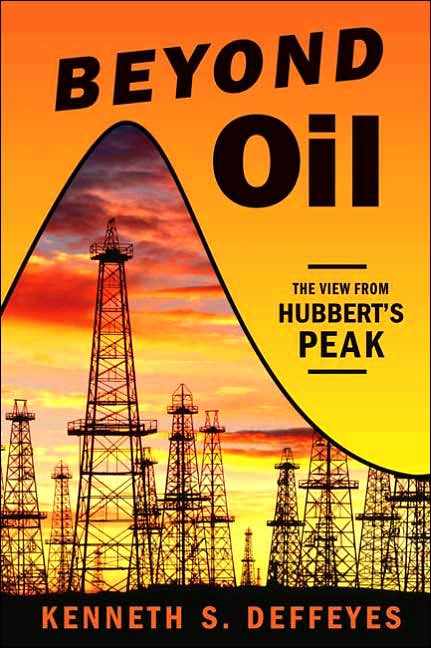
Peak Oil is a common concern and a scientific theory that would be an excellent topic for science teachers from middle school and up to discuss or teach about in the science class. It is especially fitting to use in Earth Science, Environmental Studies, or History of Science areas.

I created a WORDLE from the preface text of Kenneth S. Deffeyes 2005 book, Beyond Oil: A View from Hubbert's Peak.
Sunday, May 25, 2008
CR2.0: Just in Time Science Resources
While reading the new discussion items at Classroom2.0, I came across a request from a student, Mike P, in the Web 2.0 Class. Mike's request was to find
Cellular Biology recommendations were first made by Michelle Eckstein, Shaun Fletcher and Britt Gow. Here is my response to the excellent request:
...good sites where [I] can find videos or even a good podcast for cellular biology?
Cellular Biology recommendations were first made by Michelle Eckstein, Shaun Fletcher and Britt Gow. Here is my response to the excellent request:
Good recommendations from all. I have used the Cells Alive website which is excellent, as are the others.
I would like to recommend a science education portal BioInteractive. Their motto is, "Teach Ahead of the Textbook", and BioInteractive is part of a worldwide effort by research scientists to help more people learn about science. Their focus at BioInteractive is providing material and information for science educators and their students.
Research labs and universities provide excellent virtual labs, still images, "Holdiay Lectures" on a science topic, videos, podcasts and so much more. I have used various BioInteractive materials with 6th - 12th grade students. Many of the materials could be used with younger students.
You can sign up for the HHMI Bulletin. The May Issue
would be very helpful to teachers. Also, you can receive their newsletter and get science research and news updates that can be used as current events for science or professional development information.

Wednesday, January 16, 2008
Choosiness, Cooperativeness Historically Linked
This is an scientific abstract from a research group who is studying the effect of choosing to be associated with people who cooperate and the ways that this cooperation can encourage others to choose them.
It's too bad that Nature magazine couldn't have been more COOPERATIVE and released this research a free article, then more of us would have access to it and could CHOOSE to learn more about Nature and its parent organization.
Hmm! Maybe that is the point the staff at Nature is choosing not to cooperate with the "great unwashed", so we will not choose to cooperate or even try to learn more about them. Maybe they fear the loss of their exclusivity?
It's too bad that Nature magazine couldn't have been more COOPERATIVE and released this research a free article, then more of us would have access to it and could CHOOSE to learn more about Nature and its parent organization.
Hmm! Maybe that is the point the staff at Nature is choosing not to cooperate with the "great unwashed", so we will not choose to cooperate or even try to learn more about them. Maybe they fear the loss of their exclusivity?
 clipped from www.nature.com clipped from www.nature.com
Explaining the rise and maintenance of cooperation is central to our understanding of biological systems1, 2 and human societies3, 4. When an individual's cooperativeness is used by other individuals as a choice criterion, there can be competition to be more generous than others, a situation called competitive altruism5. evolution of cooperation between non-relatives can then be driven by a positive feedback between increasing levels of cooperativeness and choosiness6 in a situation where individuals have the opportunity to engage in repeated pairwise interactions, the equilibrium degree of cooperativeness depends critically on the amount of behavioural variation that is being maintained in the population by processes such as mutation. important role of lifespan in the evolution of cooperation.
|


Tuesday, December 11, 2007
Clearing 4040 at Catal Hoyuk
A good example of what an area looks like when it is first being cleared of topsoil so the excavation and careful mapping of the site as it is worked can be documented for later research by Ian Hodder and his world renowned team.

South Excavation
Another perspective of the rooms within the city of Catal Hoyuk and the depth of the archaeological site which provides a glimpse of the layers of cities that were built upon one another, just as they are today in major cities across the globe.
This is another part of the Catal Hoyuk site that is excavated and researched by Ian Hodder and his world renowned team.

This is another part of the Catal Hoyuk site that is excavated and researched by Ian Hodder and his world renowned team.
Tourists visiting Çatalhöyük
This picture provides better perspective for the size of ONE of the ongoing excavations at Catal Hoyuk. This city was settled for over 2,000 years by people we are only beginning to discover. When visiting Turkey, this would be an excellent tour destination.

View From Top of the Mound
Showing perspective of the site is very important. What does this area around Catal Hoyuk look like today? How did it look over 9,000 years ago? How do scientists discover this?
These are all questions that you can learn more about at the Catal Huyuk website and by studying these pictures at Flickr. Many of the techniques are straightforward and are used by historians and genealogy buffs to find the age, climate or setting of more current archaeological sites like old homesteads or cemeteries.

These are all questions that you can learn more about at the Catal Huyuk website and by studying these pictures at Flickr. Many of the techniques are straightforward and are used by historians and genealogy buffs to find the age, climate or setting of more current archaeological sites like old homesteads or cemeteries.
Monday, December 10, 2007
Wall Relief in TP Area - 1
Look above the wall relief and you can see part of the extensive roof covering this area while it is being excavated, referenced, and translated by Ian Hodder and his world renowned team.

Pot with faces from 4040 Area - 1
Beautifully crafted pottery face recovered from Catal Hoyuk by Ian Hodder and his world renowned team in 2007.

Animal Stamp Seal
One of the more recent finds in the city of Anatolia referred to as Catal Huyuk that is being scientifically investigated and referenced for study by Ian Hodder and this world renowned team.

Civilizations Before Earlier Polar Meltdowns
Several pictures from the most recent archaeological dig at Catal Hoyuk in Turkey are posted above this entry (Monday and Tuesday postings. While this blogposting reports on the latest old city to compare with Catal Hoyuk, as it gains world wide attention.
The BBC has recently published information about the ancient city that was discovered of the coast of India while engineers and scientists were study pollution. I am glad this Indian site, on the western side of peninsula in the Bay of Cambay, is finally being publicized. It is very exciting because these cultures don't just spring up fully formed...they must grow and develop.
This new discovery in the Gulf of Cambay will help people learn more about our human history, and how a previous melting of the polar ice caps covered cities and civilizations around the globe.
This site, found in the Bay of Cambay, has at least one sister city. Catal Huyuk and its discovery broke the 6,000 year barrier for civilizations and cities. Now places like Cambay will be more easily accepted.
Here are several links that will provide information about the 9,500 year old city that was discovered over 50 years ago by James Mellart and has been studied by Ian Hodder and his world renowned team since 1993.
http://www.catalhoyuk.com/
http://www.bbc.co.uk/radio4/science/unearthingmysteries_20021112.shtml
http://www.ask.com/web?q=Catal+Huyuk
The BBC has recently published information about the ancient city that was discovered of the coast of India while engineers and scientists were study pollution. I am glad this Indian site, on the western side of peninsula in the Bay of Cambay, is finally being publicized. It is very exciting because these cultures don't just spring up fully formed...they must grow and develop.
This new discovery in the Gulf of Cambay will help people learn more about our human history, and how a previous melting of the polar ice caps covered cities and civilizations around the globe.
This site, found in the Bay of Cambay, has at least one sister city. Catal Huyuk and its discovery broke the 6,000 year barrier for civilizations and cities. Now places like Cambay will be more easily accepted.
Here are several links that will provide information about the 9,500 year old city that was discovered over 50 years ago by James Mellart and has been studied by Ian Hodder and his world renowned team since 1993.
http://www.catalhoyuk.com/
http://www.bbc.co.uk/radio4/science/unearthingmysteries_20021112.shtml
http://www.ask.com/web?q=Catal+Huyuk
Subscribe to:
Posts (Atom)

 Posts
Posts





 Blinklist.com
