Fossil Fieldtrip Guide: fossil, poster, practice | Glogster
Use Glogster to make an interactive science poster.
Showing posts with label Earth Science. Show all posts
Showing posts with label Earth Science. Show all posts
Tuesday, November 17, 2009

Sunday, October 25, 2009
Using Animoto For Presentations
Using this sample Animoto video as a guide. You may use the Animoto web application to build a video from images and videos. Add your own music, or use the music available on the web application.
The video you create can represent one part of your Biodiversity presentation and can be transferred to Youtube or other presentation media.
The video you create can represent one part of your Biodiversity presentation and can be transferred to Youtube or other presentation media.
Thursday, December 11, 2008
Earth System Science: What is it?
Since World War II, the explosion in scientific knowledge naturally led many scientists and educators, to specialize in one discipline or another. Even within a scientific discipline, such as ecology, now called environmental studies, there were many specializations. Some include water ecology, habitat studies, population studies, etc. After a half century, the over-emphasis on specialization became so pronounced, that many believed that integration among various scientific disciplines must be established anew.
 This integration is most pronounced in the scientific disciplines representing any part of studies of the Earth, namely Geology, hydrology, meteorology, biology and others. A new integrated Earth Science discipline, referred to as Earth System Science, was created. The push for this integration with Earth Science was promoted most actively by the National Science Foundation (NSF) and the National Aeronautic and Space Administration (NASA).
In most scientific and education quarters, it is now recognized that people can understand how the Earth works and how we interact with the Earth, if we teach the subject in a more project based manner. Earth Science teachers are encouraged to include all the systems of the Earth in their classes. If Earth Science teachers have a greater understanding of the various spheres of the living and nonliving parts of the Earth as a system, they can effectively explain and teach Earth System Science.
To encourage you to have a basic understanding of the Earth System Science as a scientific discipline, I have included an Earth System Science WebSlide.
 This integration is most pronounced in the scientific disciplines representing any part of studies of the Earth, namely Geology, hydrology, meteorology, biology and others. A new integrated Earth Science discipline, referred to as Earth System Science, was created. The push for this integration with Earth Science was promoted most actively by the National Science Foundation (NSF) and the National Aeronautic and Space Administration (NASA).
 In most scientific and education quarters, it is now recognized that people can understand how the Earth works and how we interact with the Earth, if we teach the subject in a more project based manner. Earth Science teachers are encouraged to include all the systems of the Earth in their classes. If Earth Science teachers have a greater understanding of the various spheres of the living and nonliving parts of the Earth as a system, they can effectively explain and teach Earth System Science.
To encourage you to have a basic understanding of the Earth System Science as a scientific discipline, I have included an Earth System Science WebSlide.
Thursday, November 13, 2008
Peak Oil: View from Hubbert's Peak
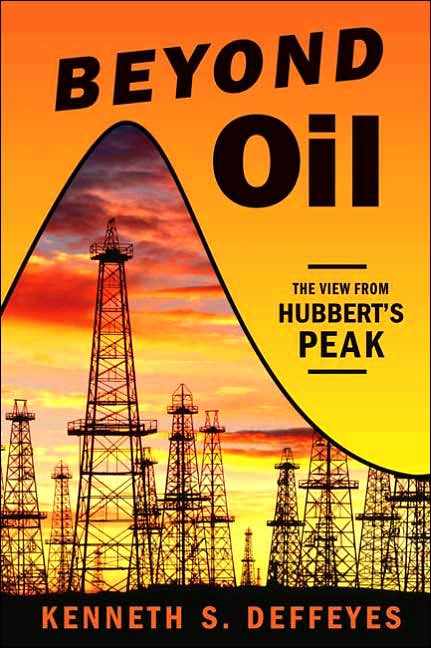
Peak Oil is a common concern and a scientific theory that would be an excellent topic for science teachers from middle school and up to discuss or teach about in the science class. It is especially fitting to use in Earth Science, Environmental Studies, or History of Science areas.

I created a WORDLE from the preface text of Kenneth S. Deffeyes 2005 book, Beyond Oil: A View from Hubbert's Peak.
Subscribe to:
Posts (Atom)

 Posts
Posts





 Blinklist.com
